Why have ship attacks near Hormuz increased?
The surge in ship attacks near the Strait of Hormuz is attributed to Iran's efforts to assert control over the vital waterway. According to experts, Iran has increased its attacks in response to the US military's heightened presence, which aims to protect tankers from Iranian strikes. The US Central Command has confirmed that commercial traffic continues with coordinated protection from US forces and regional partners.
How are oil exports affected by the attacks?
The increase in ship attacks has significantly impacted oil exports through the Strait of Hormuz. Data from trade intelligence firm Kpler indicates that oil shipments have decreased to 12.6 million barrels per day as of 13 October, down from 15 million at the end of September. This is a notable decline from the pre-war baseline of approximately 17 million barrels per day. The disruption has been exacerbated by Iran's insistence on alternative shipping routes closer to its shores, which it claims are unauthorized.
What are the strategic responses from Iran and the US?
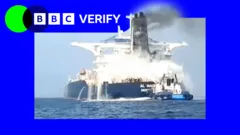
In response to the US military's increased protection of tankers, Iran has evolved its strategy by expanding its attacks beyond the Strait of Hormuz. The Islamic Revolutionary Guard Corps (IRGC) has announced new deployment formations across the region, targeting ships near Gulf Arab states and the Gulf of Oman. This includes a recent attack on a tanker north of Qatar, resulting in multiple casualties, and another near the UAE town of Al-Jazirah al-Hamra.
Impact on regional security
The escalation of attacks has heightened tensions between Iran and the US, with potential implications for regional security. The US Navy has reported an 85% increase in the number of vessels assisted through the strait in early October compared to August. This increased military presence aims to deter further attacks and ensure the safe passage of commercial vessels.
What are the broader geopolitical implications?
The ongoing conflict and increased ship attacks have broader geopolitical implications, particularly concerning global oil markets and regional alliances. The disruption of oil exports through the Strait of Hormuz, a critical chokepoint for global energy supplies, could lead to increased oil prices and economic instability. Additionally, the conflict may strain relations between Iran and Gulf Arab states, further complicating diplomatic efforts in the region.
What measures are being taken to ensure maritime safety?
To ensure maritime safety, the US and its regional partners have intensified their efforts to protect commercial vessels navigating the Strait of Hormuz. This includes coordinated military escorts and increased surveillance to detect and deter potential threats. The use of a "shuttle" system, where smaller tankers transfer oil to larger vessels in the Gulf of Oman, has also been implemented to mitigate risks associated with direct passage through the strait.
Frequently asked questions
What is the Strait of Hormuz?
The Strait of Hormuz is a narrow waterway connecting the Persian Gulf to the Gulf of Oman, serving as a critical chokepoint for global oil transportation.
Why is the Strait of Hormuz important?
Approximately 20% of the world's oil passes through the Strait of Hormuz, making it a vital route for global energy supplies.
Who is responsible for the recent ship attacks?
Experts attribute the recent ship attacks to Iran, which is reportedly attempting to assert control over the Strait of Hormuz amid increased US military presence.
How has the US responded to the attacks?
The US has increased its military presence in the region, providing coordinated protection for commercial vessels navigating the Strait of Hormuz.
What impact do the attacks have on oil prices?
The disruption of oil exports through the Strait of Hormuz could lead to increased oil prices and economic instability globally.
Key takeaways
- Ship attacks near the Strait of Hormuz have reached a record high, impacting oil exports.
- Oil shipments through the strait have decreased to 12.6 million barrels per day.
- Iran has expanded its attacks beyond the Strait of Hormuz, targeting ships in the Gulf of Oman.
- The US has increased its military presence to protect commercial vessels.
- The conflict has broader geopolitical implications, affecting global oil markets and regional security.