Why did President Trump cancel the livestream of the Nidal Hasan execution?
President Donald Trump revoked the plan to broadcast Nidal Hasan's execution online following widespread condemnation from human rights organizations and global leaders. Although the President initially supported the idea of a livestream to serve as a deterrent, he later stated on Truth Social that "many very good and well meaning people would rather not watch him die."
The President maintained that the execution itself remains scheduled, noting that Hasan will still die by firing squad. Trump argued that while the livestream could have demonstrated how the United States handles terrorists, he ultimately decided to respect the sentiments of those who found the prospect of watching a death online objectionable. Despite this reversal, Trump emphasized that the families of the victims retain the right to witness the event in person, stating they "deserve to witness JUSTICE!"
The shift in presidential stance
The decision process involved a period of public uncertainty. After the Pentagon first announced the plan to air the execution, Trump appeared to hedge his position. On Friday, he claimed he "absolutely" approved of the plan but noted that the Pentagon was still in the process of making a final determination. This oscillation between support and hesitation preceded the final cancellation announced on Thursday.
What are the details of the Nidal Hasan case and the scheduled execution?
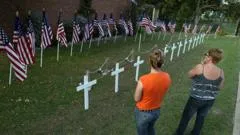
Nidal Hasan is scheduled to be executed by firing squad on December 3, 2026, marking the first military execution in over 60 years. Hasan, a former US army psychiatrist, was convicted for the 2009 attack at a military base in Texas, where he fatally shot 13 unarmed military personnel and injured 32 others.
The attack occurred in a crowded medical building where soldiers were receiving vaccines and medical check-ups. During his 2013 court martial, Hasan admitted to being the gunman and apologized for "any mistakes," though he claimed his actions were motivated by a desire to protect Muslims and the Taliban in Afghanistan from the US military. The incident remains the deadliest non-combat attack ever recorded on an American military base.
Legal requirements before the execution
Before the firing squad can proceed, the case must undergo a mandatory appellate review. This process requires a higher court to inspect the decision and provide a final judgment on its legality. This ensures that all judicial protocols are strictly followed before the sentence is carried out.
How did the Pentagon and US officials respond to the cancellation?
The Pentagon has confirmed that the decision to cancel the livestream was made in coordination with the Secretary of Defense. A Pentagon spokesman, Sean Parnell, stated that Defense Secretary Pete Hegseth has spoken with the President and that the two are "completely aligned" regarding the reversal.
Prior to the cancellation, Secretary Hegseth had defended the idea of a televised execution, arguing that the public needed to understand the "serious consequences" associated with such acts of violence. However, the administration has now moved to close the matter by focusing on the execution itself rather than its digital distribution.
Legal criticism of the initial plan
John Galligan, a lawyer representing Hasan on civil matters, criticized the original decision to livestream the event. Galligan argued that the initial plan by Secretary Hegseth violated existing Army regulations and described the attempt to broadcast the death as a "dumb decision." He suggested that the Army is now attempting to manage the fallout from a decision that could leave a permanent mark on the military justice system.
What is the global context of public executions?
The decision to livestream the execution drew sharp criticism from international bodies, including the United Nations, which described the plans as "abhorrent." While the US moves toward a military execution, the global landscape of capital punishment shows a trend toward privacy, though public executions still occur in specific jurisdictions.
According to Amnesty International, while there were more than 2,700 executions across 17 different countries in the previous year, only two nations conducted them publicly. Data from 2025 indicates that 11 public executions were recorded in Iran, and another six took place in Afghanistan. The controversy in the US highlights the tension between using capital punishment as a visible deterrent and adhering to international human rights standards regarding the dignity of the deceased and the prevention of state-sponsored spectacle.
Frequently asked questions
Who is Nidal Hasan?
Nidal Hasan is a former US army psychiatrist who carried out a mass shooting at Fort Hood, Texas, in 2009. He killed 13 military personnel and injured 32 others. He was convicted of these crimes and is scheduled to be executed by firing squad in December 2026.
When is the execution scheduled to take place?
The execution of Nidal Hasan is scheduled for December 3, 2026. The method of execution will be a firing squad, which will be the first military execution of its kind in more than six decades.
Why was the livestream cancelled?
President Donald Trump cancelled the livestream following significant criticism from the public and international organizations like the United Nations. He stated that many people preferred not to watch the execution, despite his initial belief that a broadcast could serve as a deterrent.
Can the victims' families watch the execution?
Yes, the families of the victims are permitted to view the execution in person. President Trump noted that the families deserve the opportunity to witness the justice being served for the lives lost in the 2009 attack.
Is the execution definitely happening?
The execution is proceeding as scheduled by firing squad. While the digital broadcast has been cancelled, the President confirmed that Hasan will still face the death penalty as part of the military justice process.
Key takeaways
- Nidal Hasan will be executed by firing squad on December 3, 2026.
- President Trump cancelled the plan to livestream the execution following global backlash.
- The 2009 Fort Hood attack resulted in 13 deaths and 32 injuries.
- This will be the first US military execution in over 60 years.
- The United Nations described the original plan to broadcast the execution as "abhorrent."
Conclusion
The reversal of the plan to livestream Nidal Hasan's execution marks a significant moment in the intersection of US military justice and modern media. While the Trump administration initially sought to use the event as a high-profile deterrent against terrorism, the resulting international outcry and domestic concerns regarding the ethics of broadcasting a death forced a tactical retreat. The execution remains a milestone in military history, serving as a final legal resolution to the deadliest non-combat attack on a US base. Ultimately, the focus has shifted from a digital spectacle back to the solemn, albeit controversial, execution of a military sentence.