Why are student protests occurring in France?
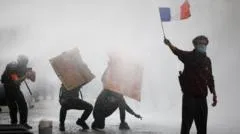
Student protests in France have been ongoing for over three weeks, with students barricading high schools and taking to the streets. These demonstrations are not isolated incidents but part of a legendary French passion for protest. The grievances are multifaceted, ranging from the immediate conditions within the school system to broader societal inequalities. In the 3rd district of Paris, students like 17-year-olds Maxime, Madeleine, and Elodie report crumbling infrastructure, including holes in classroom walls, swelling class sizes, and a severe dearth of teaching staff.
Beyond the classroom, the students are acutely aware of the wider social divide. They have expressed that while France frequently speaks of égalité (equality), the reality is a system where the poor face prejudice while the rich continue to benefit. This sense of injustice is amplified by the knowledge of the even harsher conditions in the capital's disadvantaged suburbs. For these young people, large-scale protests appear to be the only viable way to ensure their voices are heard by a government they feel has ignored them.
What role does the yellow vest movement play?
The protests are gaining significant momentum as they attract support from workers' unions and key figures from the gilets jaunes (yellow vest) movement. The yellow vest movement itself became a historic phenomenon, demonstrating against cost-of-living hikes for over a year starting in 2018, making it one of the longest-lived protest movements in French history.
Jérôme Rodrigues, a prominent gilets jaunes activist, has been actively using social media platforms like Instagram to mobilize people for upcoming demonstrations. In a recent video, Rodrigues emphasized that the struggle is about fundamental human dignity. He stated that the movement represents those who "want to be able to live decently, no longer have to count every cent, and no longer have to choose between eating and driving." His message underscores a growing sentiment that the current economic pressures transcend traditional political lines, famously noting, "Anger has no political party. An empty fridge has no political party."
Is there political manipulation involved?
As the political temperature rises ahead of next year's presidential election, the government has begun to frame the unrest through a political lens. France's prime minister, Sébastien Lecornu, suggested this week that the anger expressed by students might be being manipulated as the electoral landscape heats up. This perspective views the demonstrations not just as spontaneous outbursts of frustration, but as tools used by political actors to destabilize the current administration.
The timing of these protests is critical. With the presidential election approaching, the ability of different political blocs to capture the energy of the streets could significantly shift the national agenda. While the government points toward manipulation, the protesters maintain that their actions are a necessary response to a failing status quo, echoing the sentiment of the 19th-century author Victor Hugo, who famously urged citizens not to give in to hardship but to protest and shout.
How does the economic situation impact the protests?
The social unrest is occurring against a backdrop of severe economic instability. France, the EU's second-largest economy, is currently grappling with high government borrowing costs, a deeply divided parliament, and a revolving door of leadership—having seen six different prime ministers over the last five years. All of these leaders have claimed a desire to reduce the country's massive public debt, yet the problem remains unresolved.
Economist Anne-Laure Delatte, a CNRS Tenured Researcher at the Economics Department of Paris Dauphine University, notes that the markets are already aware of the budgetary challenges following recent elections that left parliament split between three opposing political blocs. However, she argues that France's situation is fundamentally different from previous debt crises seen in Greece or Argentina. "The markets recognised already in 2024 that we would have a budgetary problem... but they also realise France is a big country with the ability to raise taxes if necessary," Delatte explained.
What are the potential economic solutions?
The path to fiscal stability in France is fraught with political risk. Delatte suggests that the country's situation bears some resemblance to the UK in 2023 during the Liz Truss administration, where a sudden shift in fiscal policy caused market volatility. While the UK was able to right itself because markets recognized its financial tools, France faces a much more volatile social landscape.
Technically, the math for plugging the debt gap is straightforward: Delatte notes that a 4% increase in VAT could raise the 120 billion euros required to address the government debt. However, implementing such a measure in a country already experiencing widespread anger over the cost of living would be incredibly difficult. While the European Central Bank would likely intervene to prevent a total financial nosedive that could affect the rest of the eurozone, any government attempt to balance the books through tax increases or cuts to welfare and education budgets could trigger even more intense social backlash.
What are the implications for the presidential election?
The intersection of economic desperation and social anger is setting the stage for a high-stakes presidential election next spring. The protests have become a focal point for various political ideologies. For the youth participating in the demonstrations, the election feels distant, yet they question whether the constant changing of faces in power actually yields any meaningful difference in their daily lives.
The upcoming election will likely be a referendum on the country's direction. With the streets filled with students, workers, and 'mums in solidarity'—mothers like Gwen, 37, who are coordinating between students and police to protect their children during school lock-ins—the political establishment is facing a citizenry that is increasingly mobilized. The debate over how to handle the debt, how to reform education, and how to manage police conduct during protests will all be central themes that could redefine the French Republic.
Frequently asked questions
What sparked the student protests in France?
The protests were sparked by a combination of poor educational conditions—such as crumbling infrastructure and staff shortages—and broader grievances regarding economic inequality and social injustice.
Who is supporting the student protests?
The demonstrations have seen support from workers' unions, the gilets jaunes movement, and various groups of parents who are participating in solidarity with their children.
What are the main concerns of the protesters?
Protesters are primarily concerned with the cost of living, the quality of the education system, and a perceived lack of equality between the wealthy and the poor.
How might the protests affect the presidential election?
The protests are intensifying political tensions and providing a platform for various political movements as the country prepares for next year's presidential election.
What economic challenges does France face?
France is dealing with high public debt, rising government borrowing costs, and a deeply divided parliament, making fiscal reform a highly sensitive issue.
Key takeaways
- Student protests in France are driven by both local school issues and systemic social inequality.
- The gilets jaunes movement is actively mobilizing support for the current unrest.
- The government has raised concerns regarding the potential political manipulation of student anger.
- Economic solutions like VAT increases face significant hurdles due to existing social volatility.
- The upcoming presidential election will be heavily influenced by the ongoing social and economic tensions.